|
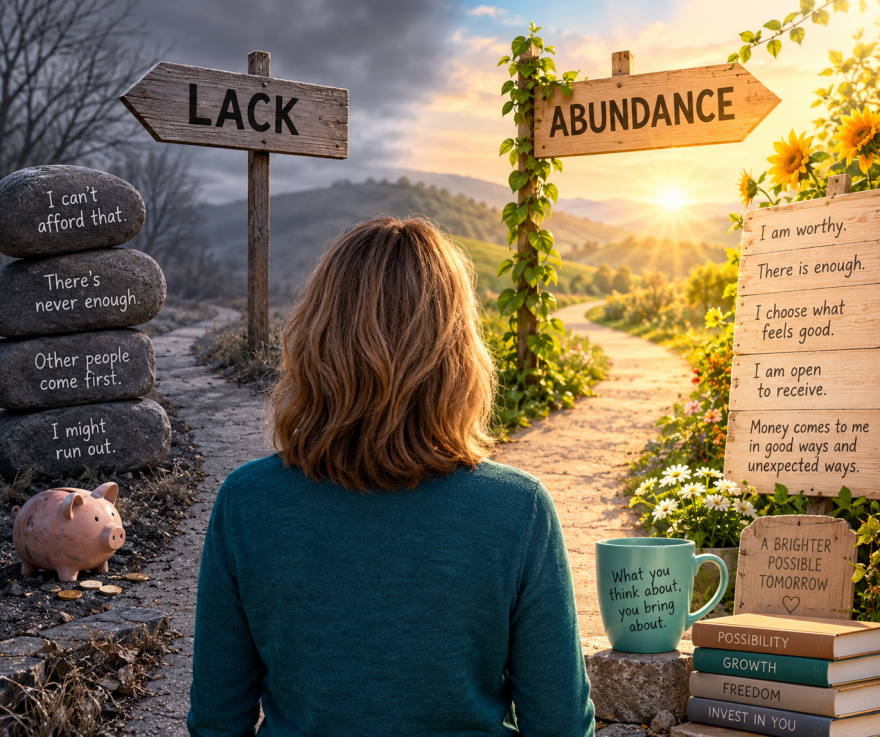 What is the true reason you feel like you never have enough money? What is the true reason you feel like you never have enough money?
Do you find yourself pinching pennies? Do you constantly think about not having enough? Do you always look for a sale and hesitate to buy something unless it is discounted? Do you go without because you believe someone else in the family needs something more than you do?
If you answered yes to any of these questions, you may be living with a lack mindset—a pattern of focusing your attention on what you don't have rather than recognizing what you do have and what may be possible.
There is an important difference between being wise with your money and living in fear around money.
Being financially responsible is a good thing. Looking for a sale is not the problem. Saving money is not the problem.
The question is: What are you thinking and feeling while you are doing it?
Are you choosing to save because it feels like a smart decision?
Or are you telling yourself:
I can't afford that.
There's never enough.
I have to be careful because I might run out.
Other people's needs are more important than mine.
But what if I told you it wasn't really about how much money you have?
What if it goes deeper than that?
Would you be curious to discover what might really be behind your thoughts and feelings about money?
My Story of "Not Enough"
I remember being a young mom, living basically on one income. I often felt that we didn't have enough money for any of the extras our family might want.
We managed to pay the necessary bills, but there wasn't much left over. One winter, I didn't even have a coat warm enough for the cold weather. I simply didn't think we could afford one, so I went without.
Another time, my son went without.
He wanted a name-brand pair of jeans that cost $80. I wouldn't allow him to buy them. After all, I thought, we could buy three pairs of non-name-brand jeans for the same amount!
So he went without the jeans he really wanted.
Looking back, I wonder: Why does that happen?
Why do we sometimes believe we can't afford not only the necessities, but even an occasional splurge—something that might make a teenager feel a little more "in" with his friends?
Where Do Our Beliefs About Money Come From?
I've wondered where some of those thoughts came from and why they lived within me for so long.
It's possible that some were carried down from my parents—and perhaps from their parents. After all, my grandparents lived through the Great Depression.
When I was a child, my dad used to say, "You didn't go without, did you?"
And I guess we didn't. We had what we needed. I enjoyed my childhood and don't remember feeling deprived or left out.
As an adult, though, I can look back and see how hard my parents worked to provide for their three children. We had new dresses at Easter and presents under the Christmas tree.
I wasn't raised hearing, "Money doesn't grow on trees!" as I know some people were.
So why, years later, did I feel there wasn't enough?
That question led me somewhere much deeper.
Did I not feel worthy of having a warm winter coat?
Was I willing to suffer so my children could have what they needed?
Why wasn't I putting on my own oxygen mask first, as we're instructed to do on an airplane?
The Belief of "Not Enough"
For many years, I had to overcome those inner thoughts running through my mind.
Eventually, I began to recognize a limiting belief that had been keeping me small:
There isn't enough.
Not enough money.
Not enough for me.
Other people come first.
I have to hold tightly to what I have.
It wasn't until I began questioning those beliefs that I started freeing myself from the bondage of "not enough."
Sometimes there is an invisible force underneath a decision—a strong, silent push that asks you to move beyond your fear.
For me, one of those moments came when I made the decision to spend $6,600 on myself to work with a coach.
For the person I had been, that was huge!
That experience helped me begin looking at money differently. Instead of seeing money as something scarce that had to be guarded, I began considering another possibility:
What if there really is enough?
Could It Really Be That Simple?
Could changing my thoughts about money change my relationship with money?
Was I holding myself back, at least in part, through my own beliefs?
As I became aware of the limitations I had placed on myself, I was able to look at money from a different perspective.
I began to see abundance.
And perhaps even more importantly, I began to believe:
I am worthy.
I don't have to put myself last.
What You Think About, You Bring About
There is a saying I have come to believe:
"What you think about, you bring about."
Think about that for a moment.
If your thoughts continually revolve around, I don't have enough. I can't afford it. Money is hard to come by. I have to hold on to every penny, what are you focusing on?
Lack.
For me, the more I focused on not having enough, the more I seemed to experience life through the lens of "not enough." I expected lack, looked for evidence of lack, and made decisions based on the fear of lack.
I believe the energy and thoughts we put out into the Universe matter. When I began changing my thoughts from there isn't enough to there is abundance all around me, I began noticing possibilities and opportunities I hadn't seen before.
It wasn't about pretending there were suddenly more dollars in my bank account. It was about changing what I expected, what I noticed, and what I believed was possible.
So pay attention to your thoughts.
Are you continually thinking about what you don't have?
Or are you beginning to recognize what you do have and opening yourself to what else might be possible?
What you focus on grows in your awareness. Choose your thoughts intentionally.
Keeping Money in Motion
Money is currency. It changes hands.
You pay someone for a product or service. Someone pays you for your work or services. That person spends some of that money somewhere else, and the cycle continues.
For me, holding onto money out of fear reinforced my feeling that there wasn't enough.
As I became less afraid to let money flow, I became more open to receiving it, too.
I started small.
I tipped an extra dollar when we went out to eat.
I began giving more to my church.
I allowed myself to go out more often without immediately feeling guilty about spending the money.
These weren't magic formulas designed to make money come back to me. They were ways of teaching myself that I no longer wanted fear to control every financial decision I made.
And I began using this mantra:
"Money comes to me in good ways and unexpected ways."
Look at the Abundance Around You
Think about nature.
Look at the leaves that cover the ground in the fall.
Look at all the apples on an apple tree.
Think about the countless snowflakes falling during a winter storm.
Abundance is everywhere when we begin looking for it.
I decided that I wanted to look at money through that same lens—not through fear, but through possibility.
That doesn't mean ignoring bills, spending money we don't have, or pretending that genuine financial difficulties don't exist.
It means becoming aware of the beliefs underneath our financial decisions.
Are we making a decision because it is financially wise?
Or are we making it because we're afraid?
That is a very different question.
As my thinking changed, I began noticing opportunities around me that I might not have noticed before. I became more comfortable giving, receiving, investing in myself, and believing that new possibilities could appear.
My old belief was:
There isn't enough.
My new belief is:
"I live in a state of abundance. I am open and ready to receive miracles."
What Is Your Money Story?
Now I invite you to think about your relationship with money.
What did you hear about money when you were growing up?
Did you learn that there was always enough—or that you had to hold tightly to what you had?
Do you find yourself saying, "I can't afford that," even before you consider whether you really can?
Do you put everyone else's needs before your own?
Do you feel guilty when you spend money on yourself?
And perhaps the biggest question of all:
Do you believe you are worthy of abundance?
Take a moment and become aware of the thoughts that come up. Don't judge them. Just notice them.
Because you can't change a belief until you first become aware that it's there.
I spent many years living from the belief of "not enough." Changing that belief didn't happen overnight, but it began with one simple realization:
I could choose to think differently.
And so can you.
What if your first step from lack to abundance isn't about changing the amount of money you have?
What if your first step is changing the way you think about it?
|